
Measuring Temperatures Through Viewport Windows
In some applications, it may not be practical to install an infrared temperature sensor directly inside the process. This can include applications where contamination must be eliminated or where hazardous conditions are present. In these cases, an IR
transmissive viewport window can be used to isolate and protect the sensor from the application or target environment.

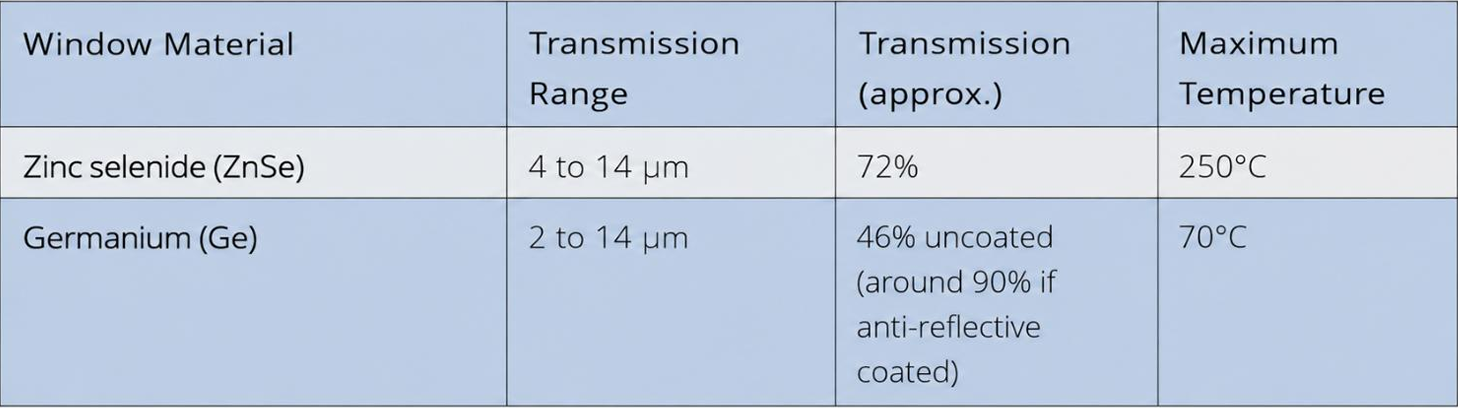
The window material suggested depends on the spectral response of the infrared sensor being used. For general purpose long-wavelength infrared sensors operating in the 8–14 µm range, materials such as zinc selenide (ZnSe) or germanium (Ge) are typically suggested, as they transmit infrared within the 8–14 µm spectral range.
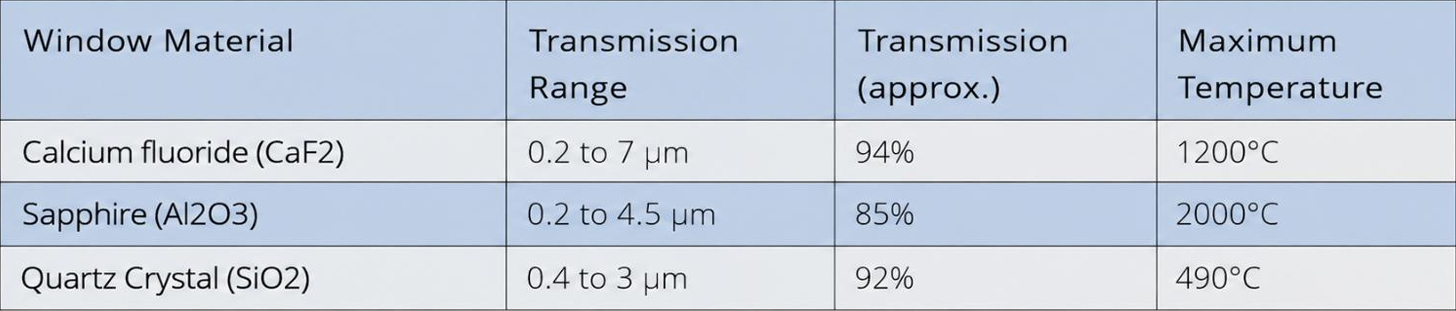
For short-wavelength sensors, such as the PyroMini2.2 and PyroUSB PUA2 (2.2 µm spectral response), materials such as calcium fluoride, sapphire, or quartz crystal may be suitable.
As viewport windows absorb and reflect a small percentage of infrared energy, the sensor should have an adjustable emissivity setting to compensate for transmission losses. The formula is as follows:
Emissivity setting = Target emissivity × Window transmission
For example, if the target emissivity of food is 0.95 and it is measured through a zinc selenide window with a transmission of 0.72, the appropriate emissivity setting for the sensor would be approximately 0.68 (0.95 × 0.72).
Please do not hesitate to contact us at sales@calex.co.uk