
Intrinsic Safety in Hazardous Areas – When is it necessary?

In hazardous environments, even a small spark or excessive surface temperature can potentially become an ignition source.
Intrinsic Safety is a protection method designed to prevent this by limiting the electrical and thermal energy within equipment and its associated circuits.
Rather than containing an explosion, intrinsically safe equipment is designed so that the energy available is insufficient to ignite the specified explosive atmosphere, even under fault conditions.
The risk
Electrical sparks and excessive heat can ignite explosive atmospheres.
The solution
Limit electrical and thermal energy to prevent ignition under certain conditions.
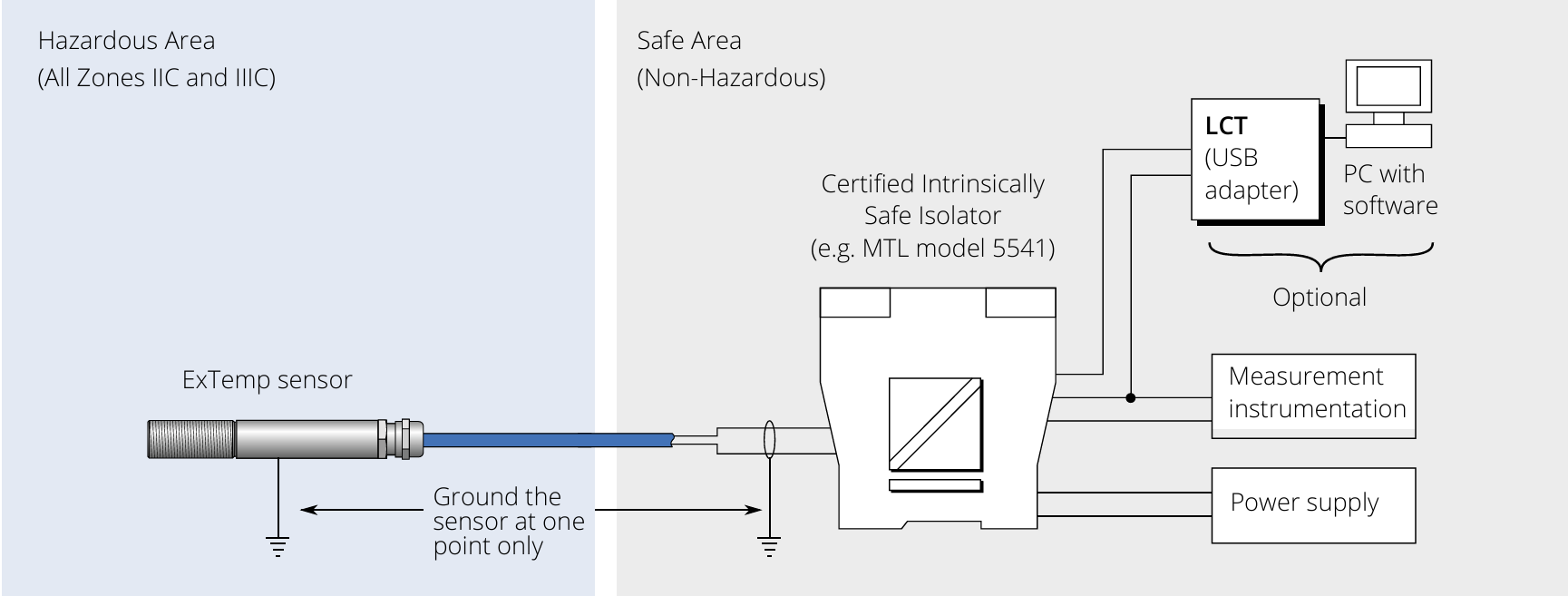
The ExTemp uses Ex ia intrinsic safety protection, allowing non-contact temperature measurement in hazardous areas classified as Zones 0, 1 and 2 (gas, Group IIC), and Zones 20, 21 and 22 (dust, Group IIIC), when used with a suitable intrinsically safe isolator.
Suggested Product

ExTemp
Intrinsically Safe Infrared Temperature Sensor
- Suitable for hazardous areas, Zone 0, 1 and 2
(gas), and Zone 20, 21 and 22 (dust), with a
suitable Intrinsically Safe isolator - Temperature range: -20°C to 1000°C
- Two wire, 4-20 mA output
- Rescalable output and adjustable emissivity
setting via optional USB and RS-485 adapters - Fast response time and high stability
- Stainless steel 316 housing – ideal for
offshore applications - IP65 sealed
- Supplied with up to 25 m cable